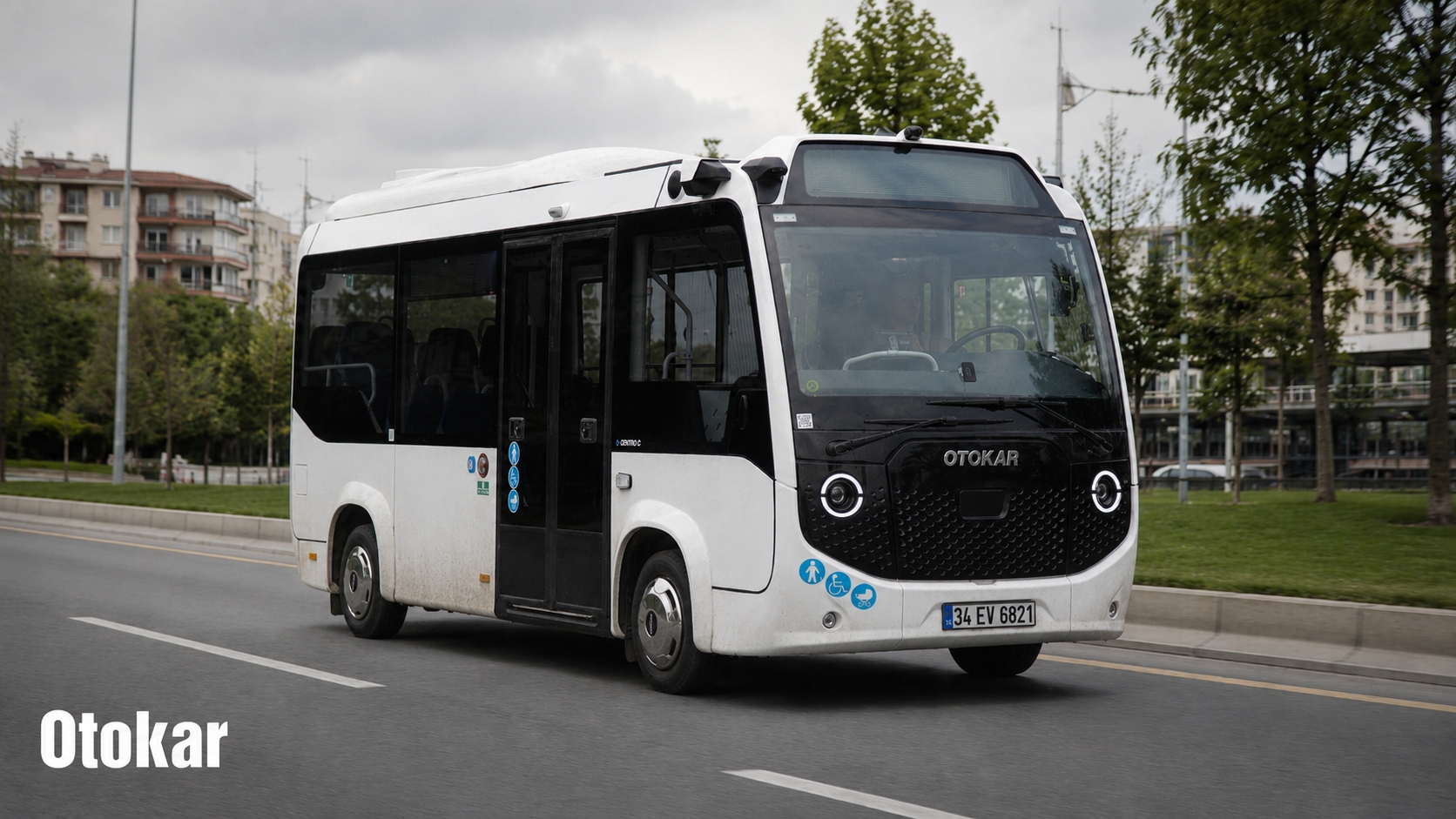
Display case information
Otokar is a well-established commercial vehicle manufacturer based in Türkiye, with a diverse portfolio spanning buses, coaches, trucks, and defense vehicles, and a growing presence in international markets. As safety regulations continue to change across the European commercial vehicle market, Otokar has been adapting its vehicle development and homologation processes for buses and trucks.
GSR2 has become one of the most important regulatory shifts for commercial vehicle manufacturers serving Europe. It requires vehicle manufacturers to integrate advanced safety systems into new vehicle types and prove that these systems meet regulatory expectations before market entry. For Otokar, this made safety compliance part of product development, not a separate step near the end of a project.
Before working with Streamax, Otokar was looking for an alternative GSR2 solution. Camera and radar‑based systems were available on the market, but they did not fully meet Otokar’s requirements for better cost efficiency, stronger technical support, and more flexibility across different vehicle platforms.
In this context, Otokar decided to cooperate with Streamax. Streamax provided the AI‑based video technology, while its local partner in Turkiye, Mobilbil, took responsibility for field integration and operations. This cooperation involved close technical coordination, on‑site integration support, and local service assistance throughout the deployment phase.
Through this arrangement, Otokar was able to access specific AI video technologies and customized solutions derived from a global OEM platform, with local technical support available at each stage of the rollout.
Otokar adopted Streamax AI camera-based safety systems to support GSR-related functions including BSIS, MOIS, DDAW, and ISA. The solution used AI video technology to help meet safety and compliance needs while giving Otokar a more flexible alternative to radar-based approaches.
The project aligns with Streamax's OEM Solution, which is designed for commercial vehicle manufacturers building GSR compliance into vehicle platforms. Streamax positions its GSR Suite as a vision-based bridge to Europe's roads and supports core regulations including ECE R151 for BSIS, ECE R159 for MOIS, EU 2021/1958 for ISA, and EU 2021/1341 for DDAW. The broader portfolio also covers ADDW, CSMS, SUMS, LDW, and AEBS, giving manufacturers room to plan future regulatory upgrades.
For Otokar, the value of the AI camera-based approach came from three areas: cost efficiency, easier adaptation across vehicle platforms, and faster implementation. Streamax's pure-vision architecture and modular camera design reduced dependence on radar-based system layouts, while the solution's commercial vehicle compatibility supported integration across M2, M3, N2, and N3 platforms. This was important for Otokar because the company needed one scalable approach for different commercial vehicle models.
The solution also supported validation work. For BSIS, MOIS, DDAW, and ISA, the system helped Otokar accelerate validation, improve data validation, support data analysis, and collect testing data more efficiently. In GSR compliance projects, this matters because regulatory readiness depends on both system performance and the evidence gathered during testing.
Local deployment support was part of the implementation model. Mobilbil acted as the local integrator, helping with field operations and technical support, while Streamax provided the AI technology, product flexibility, and engineering response needed for integration. Otokar emphasized open communication, on-site technical support, fast feedback, and strong coordination as the factors that made the project work in practice.
Through intensive testing, flexible product design, and close technical collaboration, Otokar was able to integrate the solution across vehicle platforms while addressing regulatory requirements. The project showed how a commercial vehicle manufacturer can use an AI camera-based system to manage both compliance needs and real deployment constraints.
The project helped Otokar advance its GSR compliance strategy, reduce system costs, and establish a clear path for broader deployment. Otokar is now deploying the solution in around 5,000 vehicles annually, compared with an initial project scale of 4,000 vehicles per year.
Faster validation became a clear outcome. The solution improved testing data collection and supported earlier integration, helping Otokar move forward with European market requirements and type approval-related processes.
The cooperation also created value beyond the first deployment. Otokar aims to standardize this solution across its entire fleet, with an eye toward expanding production capacity to support its growing export markets. Future cooperation may include new GSR products, upcoming regulations such as EDR, further integration across different vehicle platforms, software upgrades, and advanced driver assistance functions.
For Streamax, the Otokar project shows how AI-based video technology can support commercial vehicle manufacturers facing complex GSR compliance challenges. It also reinforces a practical lesson for commercial vehicle manufacturers: regulations should be treated as part of product development from the beginning. Starting integration early and working with the right technology and service partners can make validation, deployment, and future expansion easier to manage.