

Why Fragmented Bus Systems Limit Operations
Traditional bus solutions often rely on multiple onboard devices and independent platforms to support different business scenarios, including driver assistance, video surveillance, passenger services, and operation management. A typical bus may be equipped with separate dispatch terminals, surveillance recorders, announcement controllers, and passenger counters, each with its own interface and operating system.
However, these isolated systems often lack effective data interoperability, making it difficult to achieve unified management and seamless workflow integration. As a result, drivers must navigate multiple screens throughout a shift, increasing cognitive load and distracting from safe driving. Dispatchers and managers face a similar burden. Tasks such as tracing a safety event to a specific driver and adjusting shift assignments require switching between disconnected systems and manually transferring data, increasing deployment complexity, management costs, and operational challenges.
All-in-one: Four Solutions In One Intelligent Platform
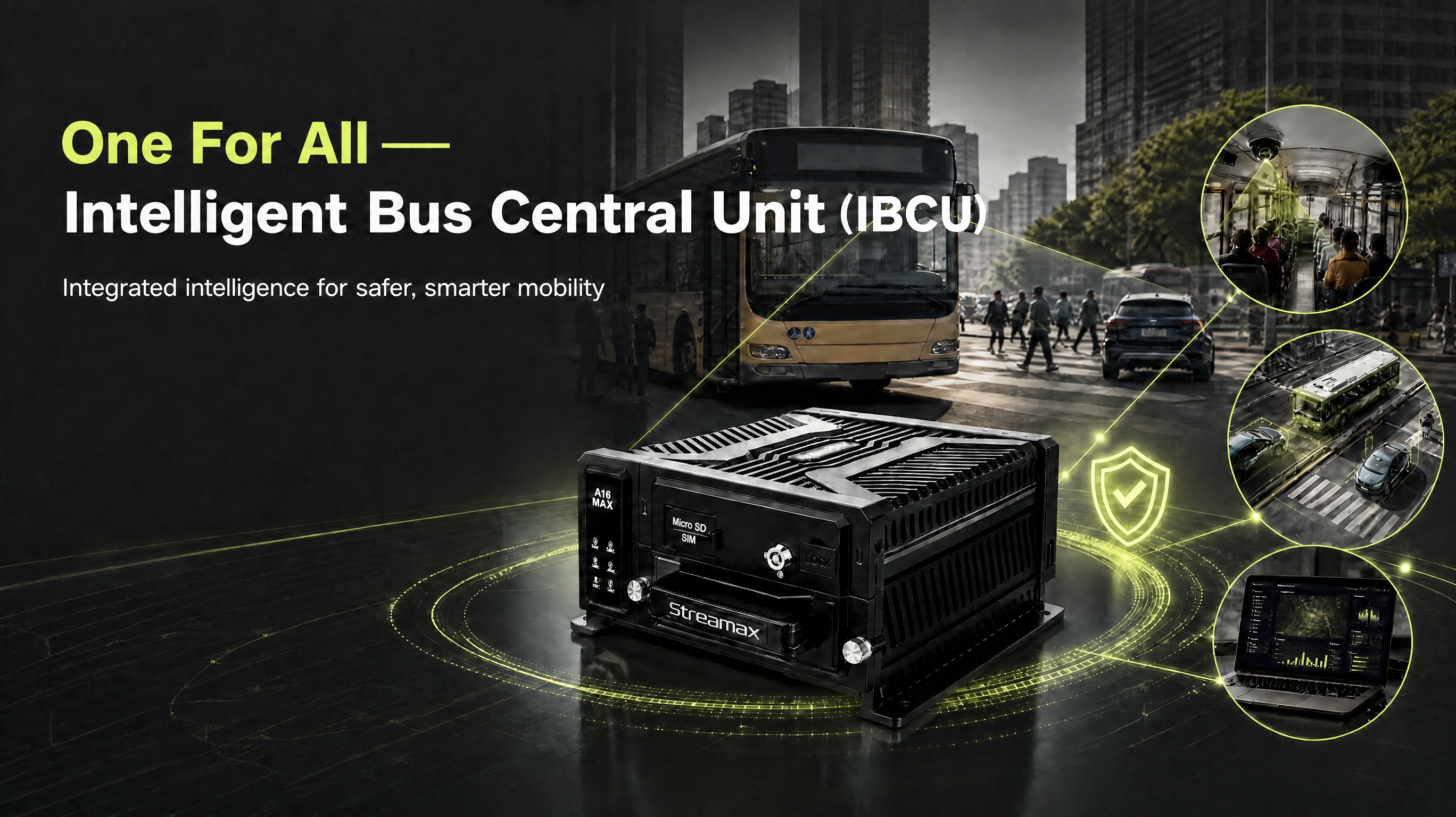
To overcome these challenges, Streamax has developed a new generation of Intelligent Bus Central Unit (IBCU). It integrates four functions: driving safety, public safety, passenger information services, and operation management into a unified platform. IBCU helps bus operators simplify system architecture, improve operational efficiency, and accelerate digital transformation. The IBCU realizes value through four pillars:
Unified Hardware Platform: The hardware platform integrates data collection, video encoding and decoding, and AI processing capabilities, and supports the simultaneous operation of multiple operating systems and software. It can help reduce the number of hardware components, lower deployment complexity and the number of potential failure points; New functions can be added through software upgrades without the need to replace the hardware.
Multi-Source Data Sharing: All data comes from the same hardware platform and follows unified formats and standards. This breaks down information silos, enabling seamless data integration and analysis across different applications and providing a more accurate basis for decision-making.
Software-Defined Products: The main functions are realized by software rather than hardware; it supports flexible configuration and expansion by third-party developers. This ensures that IBCU can "be deployed once and continuously evolve".
AI-Defined Features: Leading AI technology supports fragmented application scenarios; AI capabilities can be continuously enhanced and expanded. It can conduct real-time analysis and response to various scenarios, providing intelligent guidance for operations and decision-making.
By consolidating onboard video, safety applications, passenger information, and operational data, IBCU can reduce the number of separate systems that operators need to manage.
IBCU Hardware and Software Architecture
IBCU is designed to handle the growing data and computing demands of modern buses. With large storage capacity and high-performance computing capability, IBCU can support concurrent input from up to 24 channels of 1080p HD video and meet long-term video storage requirements of more than 90 days, depending on storage capacity and recording settings.
The platform also supports a wide range of vehicle interfaces, including CAN, IO, and serial ports, ensuring compatibility with diverse onboard systems and enabling flexible integration. IBCU supports multi-display applications, allowing multiple displays to support different functions simultaneously. For example:
- The driver operation display provides real-time information to support safer driving decisions.
- The passenger information display delivers route information and service content.
- The monitoring display enhances situational awareness and safety management.
Beyond its hardware capabilities, IBCU is built on a dual Linux + Android architecture with multi-threading design, ensuring stable and reliable performance even in complex operating environments. This architecture allows real-time safety-critical tasks to run on the Linux side while application-layer services run on the Android side, enabling parallel processing without interference.
How Can IBCU Support Safer Driving
With significantly increased computing capability compared with traditional MDVRs or standalone AI devices, IBCU provides a stronger foundation for intelligent safety applications. This increased computing capability enables four key safety applications that work together to protect the driver.
Advanced Driver Assistance System (ADAS): IBCU supports a three-camera ADAS solution that combines wide-angle, medium-focus, and telephoto perspectives, covering scenarios from close-range pedestrian detection to long-distance vehicle recognition. This multi-perspective perception capability helps identify potential risks earlier and supports safer driving.
Blind Spot Detection (BSD): Through AI-based detection algorithms, IBCU can identify pedestrians and potential risks in blind spot areas, and distinguish actual risks from non-critical situations, helping reduce unnecessary alerts while improving driver awareness.
360° Around View Monitoring (AVM): The AVM application provides a panoramic view around the vehicle, helping drivers better understand surrounding conditions and handle complex driving environments more confidently.
Driver Monitoring System (DMS): Equipped with advanced face tracking and supplementary lighting technologies, IBCU enables accurate driver status recognition under different lighting conditions. Combined with a human-factor safety analysis system powered by SafeGPT, DMS can provide more personalized safety alerts based on different driving behaviors and conditions.
Enhancing Public Safety through Intelligent Response
Beyond driver safety, IBCU also strengthens public safety for passengers and vehicle assets. Through multi-channel HD video surveillance, IBCU delivers continuous onboard recording and automatic license plate identification, providing visibility over the cabin and surrounding areas.
In emergency situations, the one-click alarm feature allows the driver to instantly trigger an alert, which is automatically transmitted to the dispatch center along with real-time video footage. This enables rapid response to incidents such as passenger disputes, vandalism, or medical emergencies, helping transit authorities enhance security, protect passengers, and safeguard public assets.
Next-Generation Passenger Information System
IBCU also redefines the Passenger Information System (PIS) architecture for future-ready fleets. In conventional setups, an MDVR needs to be technically integrated with the PIS solution, which then drives multiple PIS displays, while LED signs and audio announcements are handled separately by the host unit, resulting in a "box-to-box" wiring complexity.
For next-generation fleets, the IBCU-driven PIS solution eliminates the need for an external PIS Box. The IBCU directly drives all PIS screens, LED destination signs, and station announcement systems through its unified hardware platform, significantly reducing cabling, hardware points of failure, and overall capital expenditure. This streamlined architecture is specifically designed for cities and government agencies seeking long-term, integrated PIS governance, delivering a leaner deployment today while preserving the flexibility to scale with future AI-powered passenger services.
Data-Driven Operations Management
Beyond safety applications, IBCU also integrates Automatic Passenger Counter (APC) equipment to conduct accurate passenger flow analysis, thereby enhancing operational intelligence. Powered by advanced AI algorithms, the system adapts to different weather conditions and transportation scenarios while recognizing various passenger categories, including adults, children, wheelchair users, and bicycles. The system has demonstrated passenger counting accuracy of up to 99% and OD accuracy of up to 85% under defined test conditions, providing reliable data support for ticket verification, route optimization, and future operational planning.
By integrating multiple onboard systems into a unified intelligent platform, IBCU helps bus operators reduce complexity, improve efficiency, and build a more scalable transportation ecosystem. Business integration minimizes hardware requirements and simplifies system deployment, helping reduce overall construction costs. Through unified management and data sharing, IBCU improves daily workflows and supports more efficient operational decision-making.
In Santiago de Chile's RED electric bus fleet, more than 150 buses in the initial batch have been equipped with the full IBCU solution, enabling integrated management of safety, operations, and passenger counting. METBUS partnered with Streamax to implement a fully integrated "All-in-One" solution, in which real-time data, driver monitoring, and fleet management were consolidated into a single platform. IBCU solution delivers real value through improved safety, streamlined operations, and an enhanced passenger experience.
Future-Ready Fleet Transformation Starts Here
The IBCU intelligent solution, with its powerful hardware platform, extensive access capabilities and high openness, will enhance the functionality of various business systems, expand system integration, and improve data application accuracy. It will help enterprises achieve the goals of reducing intelligent construction costs, standardizing management and providing better services.
If your fleet is ready to make comprehensive improvements to public transportation operations, Streamax can help. Contact us about public transit solutions.