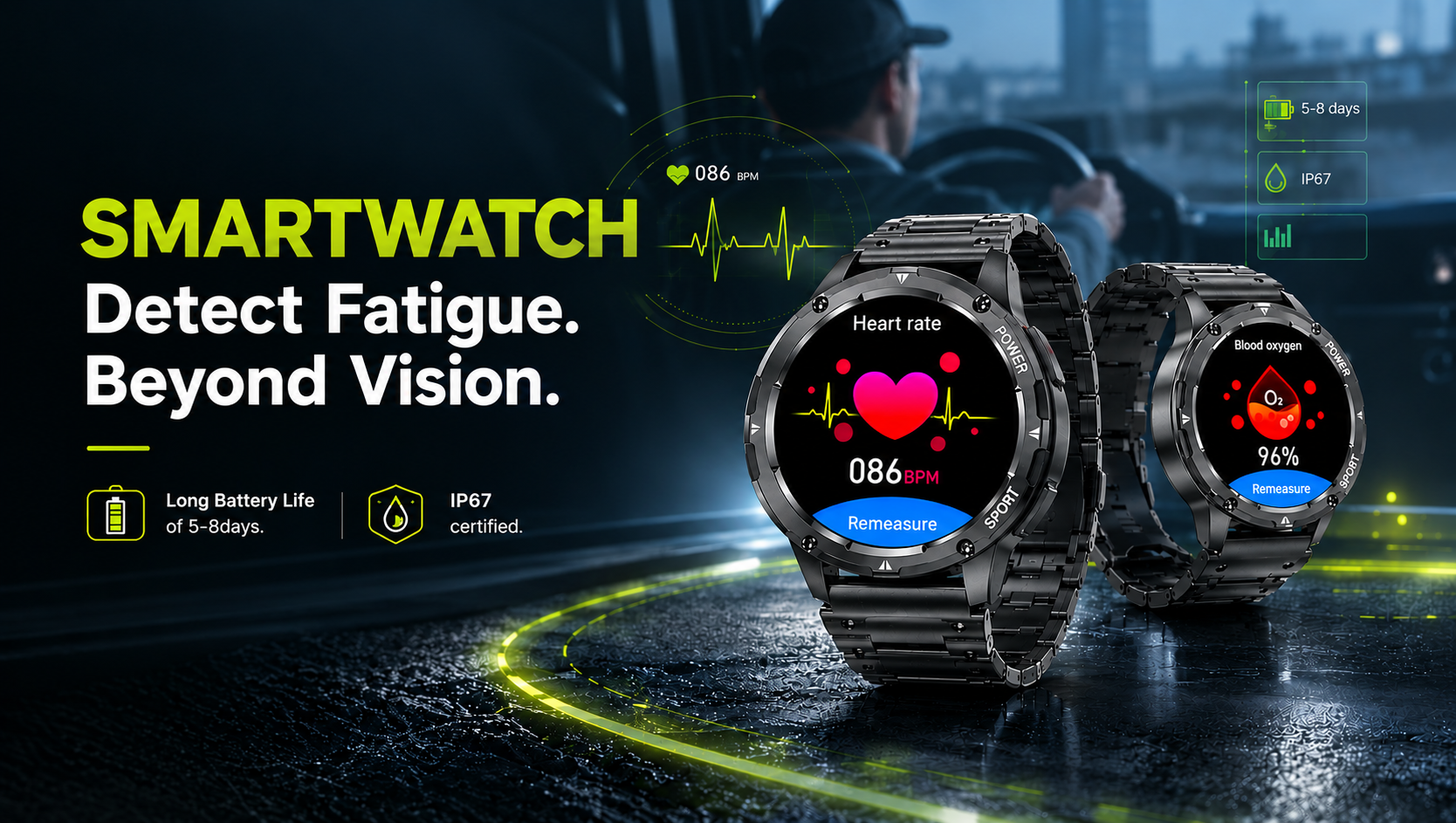


Why Camera-Based Driver Fatigue Detection May Not Be Enough
Mining operations present a unique fatigue challenge. Long shifts, repetitive haul routes, and continuous 24/7 operations can place sustained demands on drivers, making fatigue an important factor in mining safety management. In demanding mining environments, Driver Monitoring Systems (DMS) can help identify fatigue-related behaviors and provide timely warnings, supporting fatigue management in 24/7 mining operations.
As the industry moves toward more proactive, data-driven risk control, fatigue detection is increasingly becoming part of the broader safety system rather than a standalone driver-monitoring function. Within the EMESRT 9-Layers of Defence framework, fatigue warnings are positioned within advisory controls that help operators respond to emerging risks.
In Latin American mining operations, these challenges can become particularly pronounced. Strong sunlight often requires drivers to wear protective glasses, while lens reflections and partial occlusion can make it more difficult for cameras to capture key facial and eye features. As a result, environmental conditions may affect the reliability of vision-based fatigue detection.
This does not mean that camera-based DMS is insufficient on its own. Rather, it highlights the value of adding another source of information when visual cues are difficult to capture. Physiological signals collected from a wearable device, such as a smartwatch, can provide a complementary perspective on the driver’s condition, helping the system assess fatigue beyond what can be observed through the camera alone.
How Smartwatch Data Supports Driver Fatigue Assessment
Streamax extends conventional visual fatigue monitoring by introducing a smartwatch-based physiological sensing approach. Instead of relying solely on visible driver behavior, the smartwatch continuously collects physiological data, including R-R interval (RRI) and heart rate variability (HRV), providing additional information about the driver’s physiological state.
The collected data is processed and analyzed by AI algorithms. The solution’s technical approach is based on the relationship between physiological activity and fatigue-related states, with arousal level serving as an important metric for fatigue assessment. The approach references research published in IEEE Transactions on Affective Computing.
Two physiological indicators highlighted in the solution are:
- SAI — Sympathetic Activation Index
- PAI — Parasympathetic Activation Index
The solution uses physiological indicators such as SAI and PAI to capture changes in the driver’s physiological state. In general, different fatigue states are associated with different physiological patterns. Acute fatigue is typically linked to a more activated state, while deep fatigue is associated with a more relaxed and slowed-down state. These patterns are then analyzed by a trained classification model to generate a quantified fatigue index. In this way, the detection process moves from physiological signal collection to AI-based fatigue assessment:
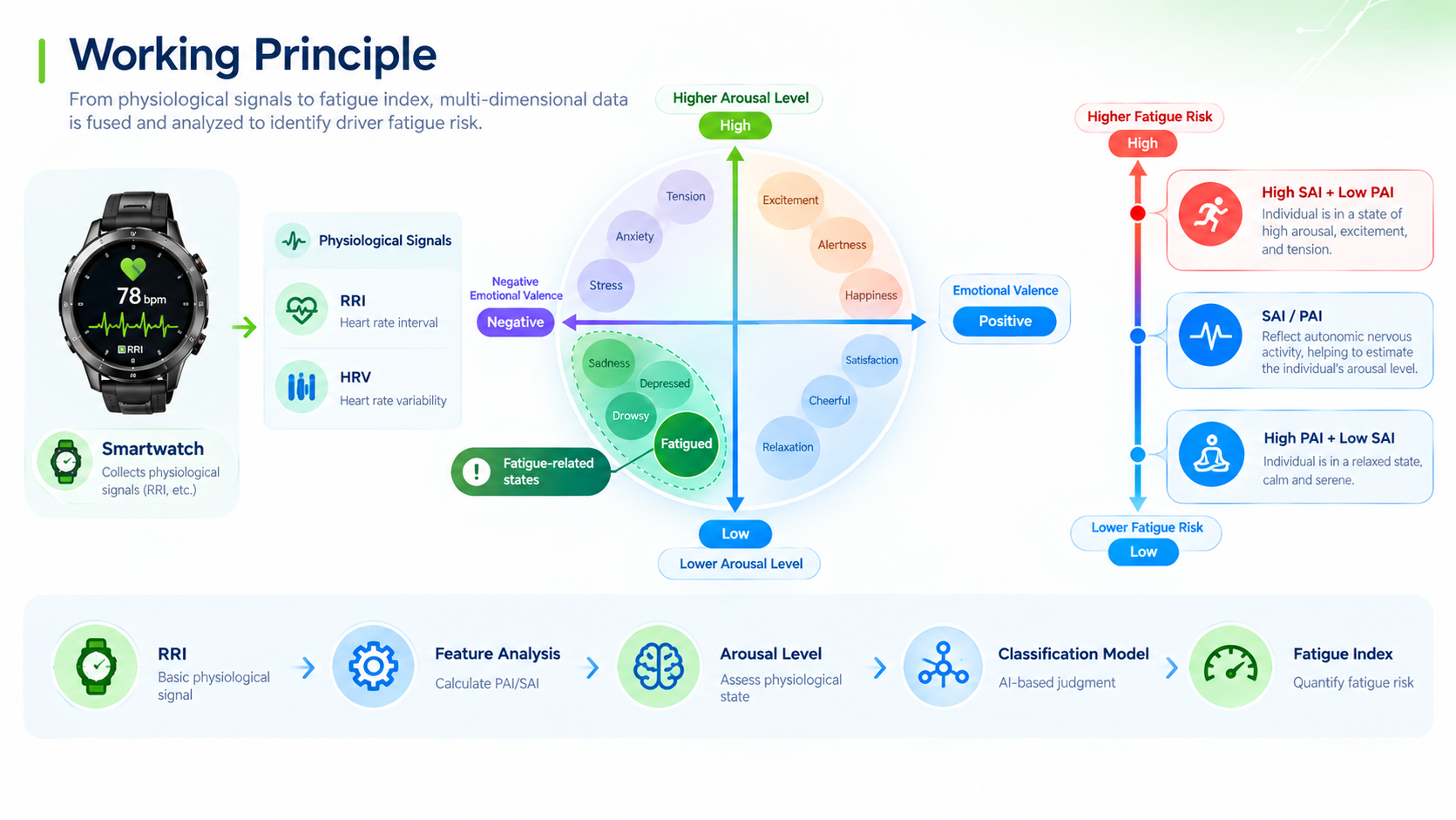
Smartwatch Working Principle
How Smartwatch and Camera Monitoring Work Together
Rather than replacing vision-based DMS, Streamax combines camera-based behavioral monitoring with smartwatch-based physiological sensing to build a more comprehensive fatigue detection architecture.
When either the smartwatch fatigue index or camera-detected fatigue behavior reaches a preset threshold, the onboard MDVR can immediately trigger an alert. The workflow includes four key layers:
Camera and Physiological Signal Collection
The system collects both:
- Camera-based visual signals
- Smartwatch-based physiological signals
This allows fatigue to be assessed from complementary sources rather than relying on visual information alone.
Real-Time In-Cab Fatigue Alerts
When a fatigue event reaches the configured alert threshold, the MDVR (M10/M10Pro) triggers an alarm. The system can also connect with a seat vibrator, providing physical feedback to the driver and prompting timely action.
This is particularly useful in demanding operating environments where a simple visual notification may not be sufficient.
Fatigue Event Recording and Evidence Management
Each fatigue alert generates an evidence package containing:
- Video footage
- Smartwatch data
The evidence package can then be automatically uploaded to the MS Cloud for further review and analysis. This connects the detected fatigue event with both visual and physiological context.
Cloud-Based Driver Fatigue Monitoring
At the platform level, MS Cloud provides real-time monitoring of drivers’ vital signs and supports deeper analysis of fatigue-related alerts.
Fleet and safety managers can therefore move beyond individual alarms toward a broader understanding of driver safety conditions and fatigue patterns.
A Closed Loop from Detection to Intervention
The value of the smartwatch is not limited to detecting physiological changes. Its greater role is to become part of a complete driver safety workflow.
The solution follows a continuous closed-loop process: it senses and analyzes the situation, alerts and intervenes when risks arise, then records the outcome and analyzes again to keep improving.
The smartwatch and camera provide sensing capabilities. AI algorithms analyze the collected data and generate fatigue assessments. The MDVR manages real-time alerts and connects the detection system with in-cab safety devices. The seat vibrator provides immediate physical intervention. Video and smartwatch data are retained as event evidence. Finally, MS Cloud provides centralized monitoring and analysis.
This architecture helps turn fatigue detection from a standalone alert function into a more complete safety management process.
Beyond Fatigue: Extending Wearable-Based Driver Safety
The smartwatch platform can also support potential applications beyond fatigue detection. The solution concept presented by Streamax includes monitoring additional physiological indicators such as:
- Heart Rate (HR)
- Blood Oxygen (SpO₂)
- Mood-related indicators
These capabilities open the possibility of extending wearable-based monitoring toward broader driver health and safety applications. For example, abnormal mood or stress conditions could support aggressive driving detection, while abnormal physiological readings could trigger health-related alerts and driver intervention.
This points toward a broader approach in which wearable devices become an additional sensing layer for intelligent driver safety.
Explore Streamax’s AI-powered mining solutions for integrated driver monitoring, fatigue detection, active safety, and fleet management. For more insights into the safety standards and risk management practices shaping modern mining operations, explore Streamax’s Global Mining Safety Standards and AI Video Telematics Compliance Guide.