

What is changing under UN R169?
UN Regulation No. 169 creates a unified Event Data Recorder framework for heavy-duty vehicles, including M2 and M3 buses and N2 and N3 trucks. Published in February 2024 and in force from June 19, 2024, it works alongside the EU General Safety Regulation, Regulation (EU) 2019/2144, known as GSR II.
For commercial vehicle manufacturers, the requirement is becoming concrete for OEM programs. From January 7, 2026, newly type-approved M2, M3, N2, and N3 vehicles in the EU must be equipped with a compliant EDR system. From January 7, 2029, the requirement extends to all new vehicles in those categories placed on the EU market.
That changes EDR from an optional accident-analysis device into a market-entry requirement. A vehicle that cannot meet the required EDR performance, data scope, survivability, and retrieval expectations may face type-approval delays or market access risk.
The purpose is not to turn commercial vehicles into rolling surveillance systems. UN R169 focuses on event data around a crash. It supports accident reconstruction, safety research, and system improvement while limiting personal data collection. The regulation avoids data types such as location, driver identity, in-cabin audio or video, and full VIN storage, which helps align the EDR concept with European privacy expectations.
Why ordinary recording is not enough after a severe crash
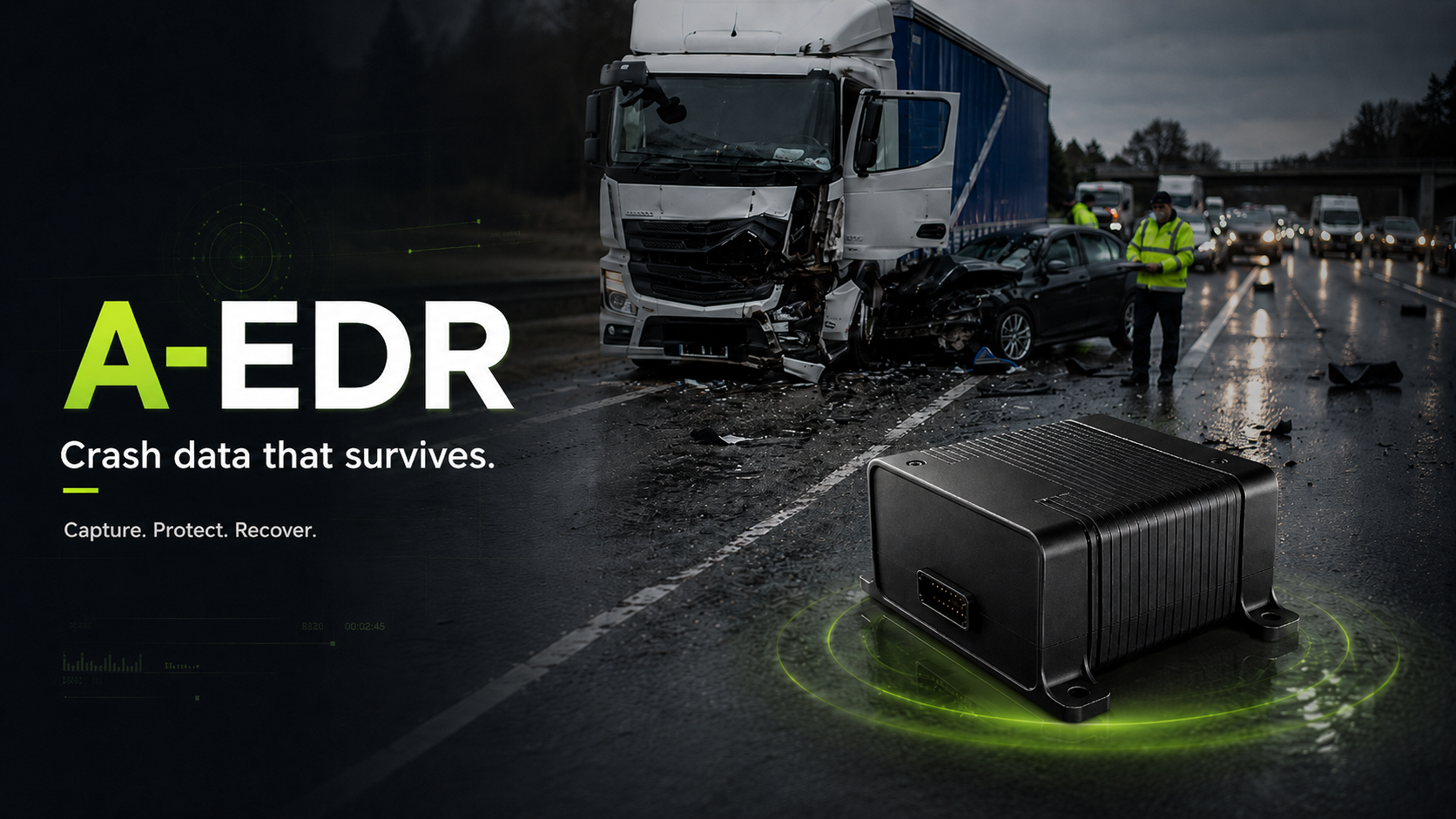
Commercial vehicle crashes are different from passenger-car incidents. A bus or heavy truck has greater mass, longer braking distance, more complex electronic systems, and higher potential damage. After a severe collision, fire, water immersion, power loss, or structural deformation, an ordinary recording device may fail exactly when the evidence matters most.
The hardest part of crash-data protection is not recording during normal operation. It is preserving data after the vehicle has already failed. In a real accident, the recorder may face cabin fire, underwater recovery, power interruption, mechanical impact, and delayed extraction. If the storage unit cannot survive those conditions, the most important data may disappear before investigators ever reach the vehicle.
That creates a practical problem for OEMs, fleet operators, insurers, and investigators. If the vehicle cannot preserve reliable crash data, the accident story may depend on damaged hardware, incomplete video, human memory, or disputed scene evidence. For OEMs, that uncertainty creates both compliance risk and post-accident dispute risk.
This is why commercial vehicle EDR should be treated as a protected recording system designed around data survivability, not just another data logger. It needs to capture the critical seconds before a crash, the crash moment, and the immediate post-crash phase. UN R169 requires data around the event, including 5 seconds before impact and the first 300 milliseconds after impact, so investigators can understand vehicle state and safety-system response.
For truck operators, this crash evidence layer sits beside broader fleet safety workflows. Streamax's Trucking Solution already connects accident detection, video evidence, driver coaching, blind-spot assistance, and operating visibility. EDR adds a more regulated, crash-survivable data layer for the moments when normal operating records may not be enough.
What a disaster-resilient commercial vehicle EDR should protect
A disaster-resilient commercial vehicle EDR should protect four things: the crash trigger, the protected memory, the physical storage module, and the post-accident data extraction path.
Fire protection matters because thermal damage can destroy storage before the vehicle is recovered. Streamax EDR applies an aviation black-box protection concept, using nano thermal insulation material and an inner water-box structure that absorbs heat through water evaporation. The system is designed to support protection under 1100 degrees C for 15 minutes while helping keep the core storage chip below its temperature limit.
Water protection matters because commercial vehicles may be recovered from rivers, tunnels, flood zones, or port and mining environments. Streamax EDR is designed to support 100 meters of water depth for 48 hours. Its fusible-metal sealing design supports long-term vehicle-grade sealing and controlled pressure release, helping preserve the protected storage area after immersion.
The system also uses a 50G high-precision acceleration sensor and crash recognition algorithm to identify the collision timing, then locks the relevant event data in an 8MB dedicated protected memory area with partitioned backup. It is designed to retain more than five major events without overwriting critical crash records.
How Streamax EDR supports compliance and accident reconstruction
Streamax EDR is built as a system-level commercial vehicle EDR solution for OEM programs that need UN R169 readiness, crash-data survivability, data security, and post-event analysis.
In practical terms, Streamax EDR works like a vehicle-side disaster recovery point for crash data. Normal fleet systems may provide video, telematics, and cloud records, but EDR protects the legally relevant event data inside the vehicle when external power, communication, or ordinary recording devices may no longer be available.
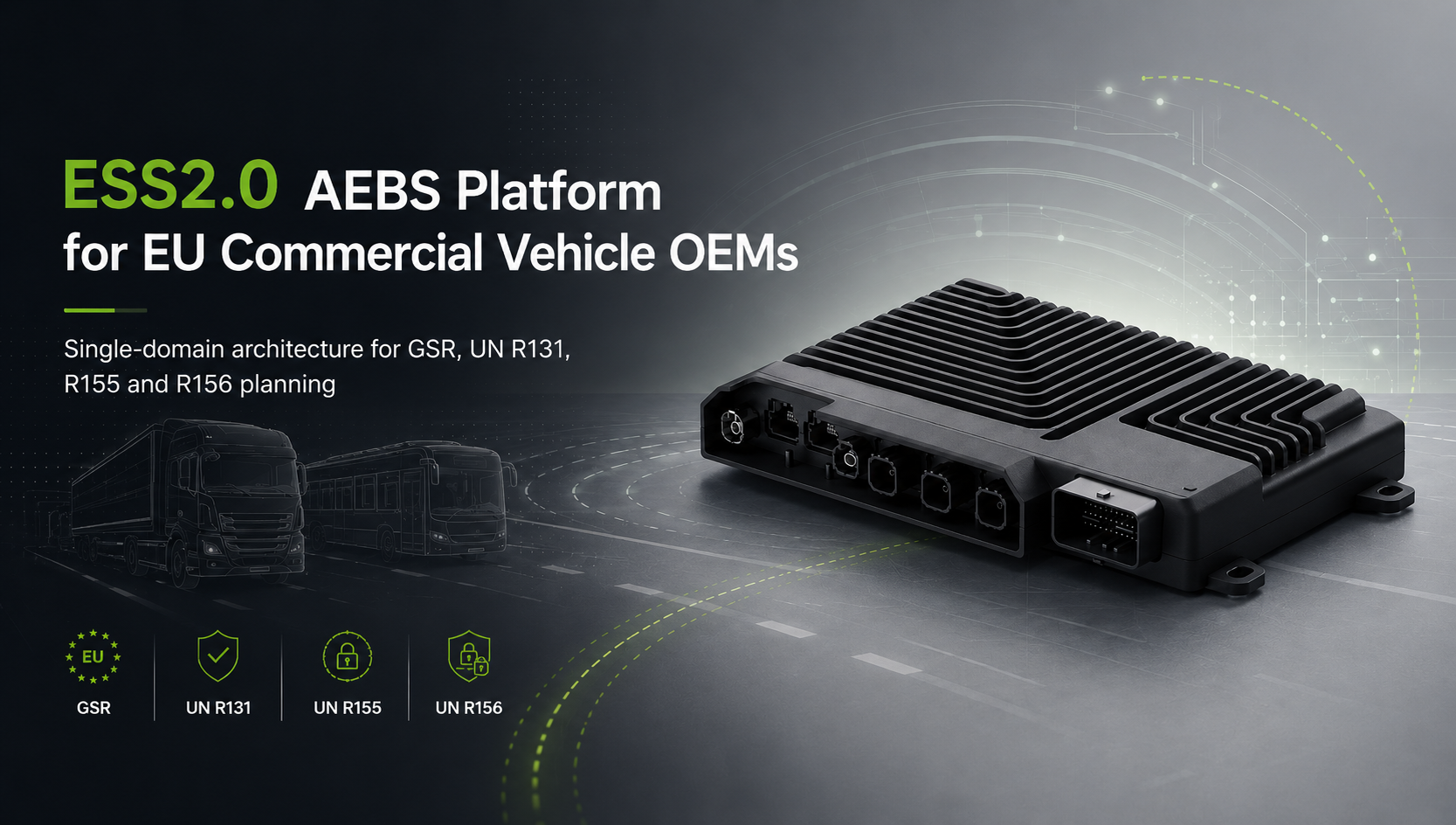
For OEMs preparing for Europe, EDR should not be evaluated in isolation. It needs to fit into the broader vehicle safety and GSR architecture. Streamax's OEM Solution covers GSR-related commercial vehicle functions such as BSIS, MOIS, ISA, DDAW, ADDW, LDW, AEBS, cybersecurity, and software update security. EDR extends that architecture by preserving what happened when an accident occurs.
In practical terms, Streamax EDR works like a vehicle-side disaster recovery point for crash data. Normal fleet systems may provide video, telematics, and cloud records, but EDR protects the legally relevant event data inside the vehicle when external power, communication, or ordinary recording devices may no longer be available.
In a crash, Streamax EDR can act as the protected data anchor inside the vehicle. It records required vehicle dynamics and safety-system status, then helps connect the evidence with related systems such as AEBS, ADAS, T-BOX, and video telematics. For new energy commercial vehicles, the solution can also send a collision signal to support fast high-voltage power cut-off logic, reducing the risk of secondary fire after impact when integrated with the vehicle's safety architecture.
That matters because modern accident analysis is no longer only about speed and braking. Investigators and engineers increasingly need to understand the chain of sensing, warning, driver response, braking, deceleration, and vehicle system behavior. A protected EDR record can help OEMs review whether AEBS, BSIS, MOIS, or other safety systems triggered as expected.
For related active-safety context, Streamax has also published an AEBS case article on how Streamax AEBS helped Shenzhen taxi fleets reduce accidents by 30%. EDR serves a different role from AEBS, but the two belong to the same safety chain: active systems help reduce crash risk, while EDR helps preserve what happened when a crash still occurs.
Why EDR data matters beyond the crash report
High-quality EDR data helps more than the immediate accident investigation. For insurers, it can reduce uncertainty by showing vehicle speed, braking state, acceleration changes, and safety-system status around the crash. That can support faster claims review and reduce disputes based only on subjective accounts.
For OEMs, aggregated EDR analysis can reveal how safety systems perform in real-world accident conditions. If AEBS triggered late, if deceleration was lower than expected, or if a blind-spot system did not produce the intended warning chain, engineers can use that evidence to improve hardware selection, calibration, and control logic.
For fleets, EDR should not replace video telematics, driver coaching, or safety management. It should strengthen them. Streamax's article on event detection and behavioral intelligence explains why isolated alerts are not enough for fleet safety. EDR answers the narrow but critical crash question. Video telematics and behavioral intelligence help teams understand risk before and after the event.
UN R169 is a compliance deadline, but it is also a product-quality test. Commercial vehicle OEMs that treat EDR as a minimal checkbox may pass the paperwork but still leave accident evidence exposed. For OEMs, the value is practical: fewer gaps in accident evidence, stronger support for type approval, clearer technical review after a severe crash, and better data for improving future vehicle safety systems.
Disclaimer: The data recorded by the Event Data Recorder (EDR) is intended solely as a technical reference for accident reconstruction, safety analysis, and vehicle system performance evaluation. The admissibility and evidentiary value of such data in any legal or regulatory proceeding are subject to applicable laws, regulations, and the discretion of the competent authorities in the relevant jurisdiction. Streamax makes no representation or warranty that the recorded data will be accepted as conclusive evidence in any specific legal or regulatory proceeding.